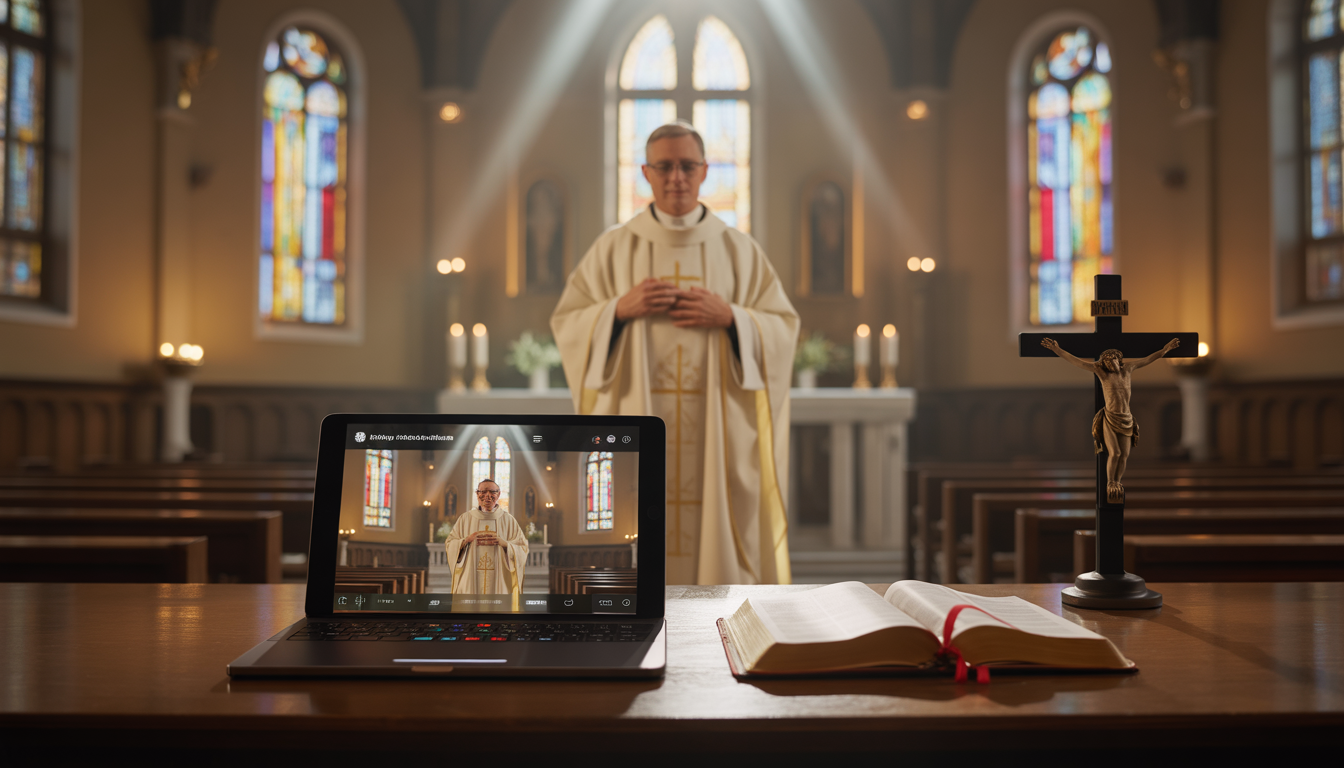
People develop religious education in response to the needs of their time. The method of delivering sermons to early Christian communities has evolved from oral preaching to printed documents and television programs, but the church’s mission has remained unchanged as a tool for helping people engage in deep thought and understanding, alongside their moral development. Catholic homilies online today continue the ancient tradition of delivering religious sermons to audiences through digital platforms.
Mass liturgical experiences remain complete because online homilies exist as additional spaces that enable people to reflect on scripture while learning different ways to understand faith outside the church building.
Understanding the Role of the Homily
The Catholic tradition uses the homily to fulfill its designated purpose. The presentation contains no formal lecture elements and does not function as a personal speech outside the biblical text. The reading explanation exists to show how sacred texts connect with actual life experiences.
The digital transmission of homilies maintains their original purpose. The only change that occurs is the ability to access the content. Listeners and readers of Catholic online homilies can choose their own time to reflect on the material, study important concepts, and read scripture at their own pace.
People today need this ability to access information because their daily activities, actual locations, and personal conditions create obstacles to attending in person.
Why Online Access Matters
The presence of Catholic homilies online is essentially a mirror of the bigger changes in how people view learning and introspection. Far from diminishing the substance, digital availability often offers the opportunity to watch again, thereby deepening understanding.
Online sermons offer chances for:
- Revisiting scriptural interpretations after Mass
- Getting ready for the next readings
- Thinking in privacy during times of change or uncertainty
- Preserving spiritual continuity in situations where in-person involvement is restricted
These applications present online homilies as instruments for prolonged contemplation rather than as alternatives to group worship.
Reflection Beyond the Moment
The immediacy of spoken homilies is one of their drawbacks. They are entirely dependent on memory after delivery. Online formats increase their longevity. Rereading, pausing, or revisiting a homily might help concepts settle over time rather than go away.
This change encourages a contemplative approach to faith that prioritizes return over instant gratification. Meaning frequently develops via repetition and reevaluation rather than in a single flash of insight.
Key Characteristics of Catholic Homilies Online
Authentic Catholic homilies, whether given in a church or online, have similar, tradition-based traits despite variations in delivery.
Usually, they are characterized by:
- A close reading of the Bible.
- The relationship between everyday life and biblical texts.
- A tone that is pastoral rather than combative.
- A focus on introspection as opposed to just teaching.
These components enable modern forms of access while helping maintain theological integrity.
The Relationship Between Authority and Accessibility
The question of authority is occasionally raised regarding digital religious content. Catholic homilies online tackle this problem by focusing on liturgical readings and established teaching rather than personal opinions.
More than its objective, the homily’s authority comes from its devotion to scripture and tradition. The audience is merely increased, and the time spent interacting is extended via online access.
Finding a balance between authority and accessibility is necessary to preserve credibility and confidence.
How Online Homilies Support Personal Faith Practice
Many people experience their faith outside of social contexts. Self-reflection is essential. This dimension is supported by online Catholic homilies, which offer structured guidance without requiring immediate involvement.
They frequently support individual practice by:
- Offering vocabulary for meditation and prayer.
- Explaining difficult or complex texts.
- Promoting moral consideration in day-to-day choices.
- Strengthening consistency throughout the liturgical calendar.
They support belief rather than guide it.
Digital Reflection and the Liturgical Calendar
Catholic homilies online that deliver their second benefit by adhering to the liturgical schedule. The seasonal themes of Advent, Lent, Easter, and Ordinary Time can be observed on the online site.
The continual process creates a contemplative practice that follows the Church’s annual schedule and helps build stronger relationships between people.
Why Homilies Remain Relevant
The value of the homily during an era of endless knowledge lies in its limitation. It is not a quest to bombard with facts or logic. Instead, it offers a focused reflection on a scripture that may touch on universal human themes such as endurance, forgiveness, hope, and responsibility.
This goal is unaffected by internet access. If anything, it strengthens it by providing room for quiet interaction away from busy schedules and settings.
Reflection Over Instruction
Crucially, Catholic homilies online are not intended to be theological guides. Reflection, not resolve, is what makes them strong. There may be unanswered questions. Instead of being resolved, tension may be acknowledged.
This transparency honors the complexity of living faith and promotes informed participation.
Key Functions of Catholic Homilies Online
Online access to Catholic homilies fulfills a number of complementing functions in modern religious practice.
They serve as:
- Liturgical reflection extensions.
- Resources for introspection, both individually and collectively.
- Scripture and tradition as anchors.
- Resources for continuity during life’s changes.
Their presence and persistence are what make them effective, not persuasion.
FAQs – An Exploration of Catholic Homilies Online
Q1: Catholic homilies online: what are they?
A: Catholic homilies online are digital renditions of scriptural reflections typically delivered during Mass and available on websites, audio platforms, or video platforms.
Q2: Do virtual homilies take the place of going to Mass?
A: No. By encouraging introspection outside of the ritual environment, they enhance face-to-face worship.
Q3: Who are Catholic homilies online for?
A: They are useful for individuals seeking continued engagement with scripture, including those unable to attend Mass regularly.
Q4: Are online homilies authoritative?
A: Their authority depends on fidelity to scripture and Church teaching, not on the medium through which they are delivered.
Q5: How can online homilies support personal prayer?
A: They offer a methodical framework for introspection that can direct introspection, prayer, and moral deliberation.