
What Daily Christian Preaching by Father Paul Dakissage Taught About Finding Peace in a Performative World
- Articles
- What Daily Christian Preaching by Father Paul Dakissage Taught About Finding Peace in a Performative World
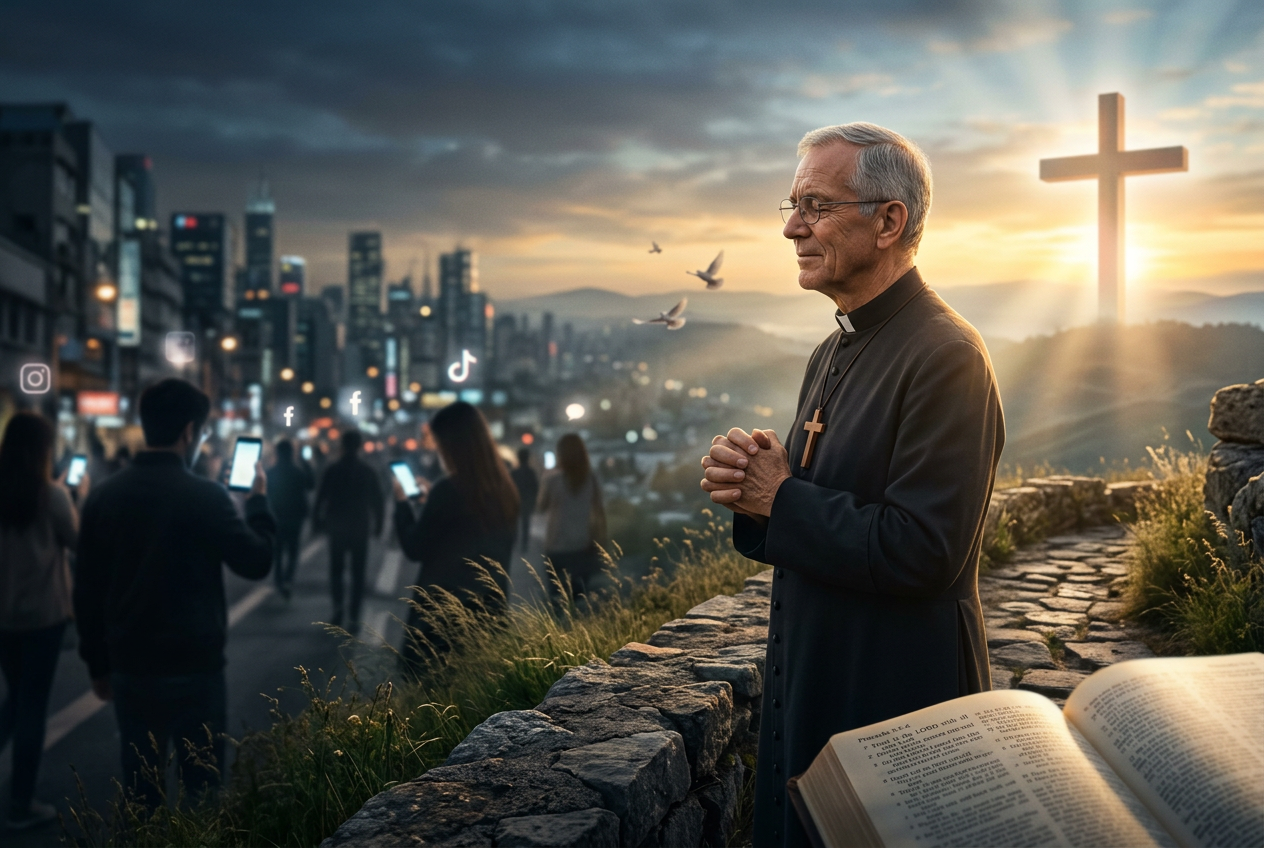
Some lessons are not taught from a pulpit. They are learned by watching someone live.
Joseph Kinda learned that way. He grew up watching his mother move through a life that offered no shortcuts. She did not have a platform. She did not chase visibility. What she had was a quiet consistency that her parish priest, Father Paul Dakissage, came to recognize over years of pastoral accompaniment.
Father Paul saw her at the altar, receiving communion with a reverence that made him stop. He saw her in the confessional, carrying a sensitive conscience without theatrical guilt. He saw her in the parish hall, cooking for the pastoral team and leading a Marian group with a humility that never demanded recognition. When he later wrote the preface for Joseph’s book, he called her life a demonstration of ordinary holiness. Not the kind that makes headlines. The kind that holds a person steady when everything around them shakes.
What Joseph’s mother carried was not a philosophy. It was a rhythm. Morning Prayer before the house stirred. The Angelus at noon, even in the middle of chores. Daily Mass reached by bicycle until she was seventy-eight. These were not performances. They were anchors.
A Spirituality That Does Not Need an Audience
There is a particular heaviness that settles on people who measure their worth by how many are watching. It is the heaviness of constant performance, of curating a life for approval that never quite satisfies. Joseph’s mother lived free of that heaviness. Not that she was untouched by struggle. She simply learned to place her identity somewhere else. At fifteen, she fled a forced marriage, walking through bush country with nothing. She was not looking for applause. She left because some things felt bigger than fear. When her second son drowned, she kept her grief close, not something she spread out for others to see.
She sat in the silence of a dark night and stayed. When a family jewel was sold to buy her son a textbook, she demonstrated that knowledge mattered more than what she possessed.
Daily Christian preaching by Father Paul Dakissage was not abstract teaching to her. It was a word that met her where she lived. In the kitchen. In the middle of loss. In the small, unnoticed choices. A life like that finds its footing. Rejection, poverty, grief—they came, but they did not knock her down.
What the World Offers vs. What Holds
A contrast emerges when you look at two different ways of moving through life.
One path asks you to prove your value through visibility. You must be seen to matter. Your worth is measured by likes, followers, titles and possessions. Adversity is something to hide or outrun. Silence feels like failure. The result is exhaustion that never ends.
Another path asks nothing of the kind. It invites you to root your worth in something that does not depend on who is watching. Visibility becomes optional. Things you own stop owning you. Adversity, when faced another way, can teach instead of crush. Silence turns into something you can actually hear yourself in. What grows from all that is a steadiness that does not rise and fall with what happens around you.
Joseph’s mother walked the second path without ever naming it. Her son, now a priest, would later call it existential self-determination. The power to define the value of one’s own life, independent of what the world says.
The Gift That Keeps Giving
What makes her story worth sharing is not that she was extraordinary. It is that she was ordinary in a way that most people have forgotten how to be. She did not try to be remembered. She just showed up, day after day, and loved the people right there in front of her.
Daily Christian preaching by Father Paul Dakissage found its way into her because she was already living what he spoke. And what she lived continues to speak. Through her son’s book. Through the preface her pastor wrote. For anyone who reads her story and realizes that a life does not have to be loud to leave a mark.
For anyone tired of the performance, there is another way. It does not require escape. It requires the slow, quiet work of aligning your life with what is true rather than what is visible. Not for recognition. Because that alignment, once made, begins to transform everything. Grief becomes survivable. Rejection loses its sting. The noise that once felt overwhelming becomes background.
That is the inheritance Joseph Kinda received from his mother. It is the same inheritance Father Paul witnessed from the altar. And it is available to anyone willing to look for holiness not in the spotlight, but in the quiet places where ordinary faithfulness takes root.
The noise of the world tells you to become someone else. It tells you to shape yourself into what others want to see. But the quiet path, the one Joseph’s mother walked, asks only that you become more fully who you already are. That was the Light She Left Behind.
There is freedom in that. Not freedom from difficulty. Freedom from pretending. You stop performing for approval and start paying attention to what actually matters. The meal you share with someone who needs company. The forgiveness you extend even when it is not deserved. The prayer you offer, even when you are not sure anyone is listening.
Daily Christian preaching by Father Paul Dakissage was not a performance either. It was a steady presence, a word offered and then lived out in the ordinary hours. That is what made it real for her. That is what can make it real for anyone who is tired of the noise.
You do not need to be extraordinary to start. You only need to take one small step toward what is true. And then another. That is how ordinary holiness grows. One quiet step at a time.
Holiness does not seek the gaze of the crowd. It dwells in the quiet offering of a life faithfully lived, known fully to God alone.
A Few Questions That Surface When You Stop Running
What does ordinary holiness actually look like?
You make a meal. You do not wait for someone to say thank you. You pray when your mind is all over the place. You forgive someone who will never even know you forgave them. Nothing dramatic. Just the next small thing. Then the next.
What if I pray and feel nothing?
That happens. A lot. You show up anyway. The showing up is what holds.
How do I get stronger before hard times come?
Keep the small rhythms. The prayer when it feels dry. The kindness no one notices. That is what stays when everything else goes.
Is peace really possible in a world this loud?
Yes. Peace is not the world being quiet. It has something underneath that does not move when the noise gets loud.
How do I stop caring what others think?
Pick something small today. Do it quietly. No one needs to know. Just because it is true for you. Do it again tomorrow. Somewhere along the way, you notice something. The people who actually matter? They never needed the show. The rest? You stop wondering what they think. It just happens.

Joseph Kind World
Lorem ipsum dolor sit amet consectetur adipiscing elit dolor
Post Info
Latest Posts
We have a problem with holiness. We imagine it needs spotlights. A stage. A dramatic conversion story with thunder and […]

We grow up thinking significance requires visibility. A brand. A following. A name people recognize. But the people who truly […]
One morning, a woman in her seventies woke up and could not make a fist… her fingers had curled overnight. […]
Some lessons are not taught from a pulpit. They are learned by watching someone live. Joseph Kinda learned that way. […]


